2026–27 Academic Programs & Curriculum
2026–27 Instructional Curriculum List (PDF)
All curriculum and supplemental materials are differentiated according to student need and aligned with applicable California State Standards and frameworks.
Learning Model · TK–8
-
Grade-level learning model
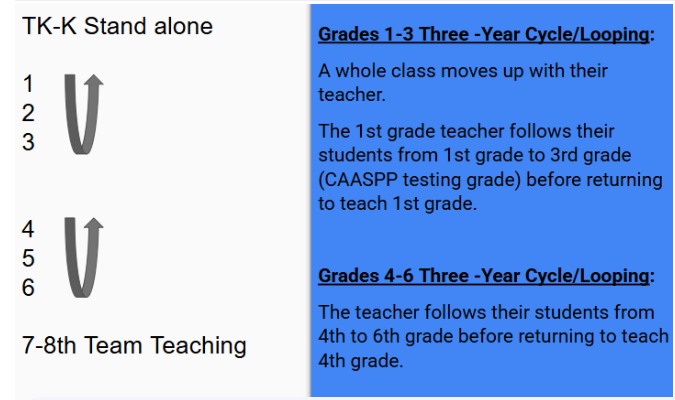
TK–K: Stand alone.
Grades 1–3: Three-Year Cycle/Looping. A whole class moves up with their teacher. The 1st grade teacher follows their students from 1st grade to 3rd grade (CAASPP testing grade) before returning to teach 1st grade.
Grades 4–6: Three-Year Cycle/Looping. The teacher follows their students from 4th to 6th grade before returning to teach 4th grade.
Grades 7–8: Team Teaching.
Baypoint Preparatory Academy–San Diego is a College-Preparatory Program that integrates Blended-Learning, Station-Rotation, and a Looping Model. Centered on Individualized Instruction, it takes a comprehensive approach to student growth by combining rigorous academics with personalized learning pathways and fostering consistent, long-term teacher-student-family relationships.
BPA-SD has implemented a K–6 looping model, in which teachers follow the same group of students over multiple years. This continuity fosters stronger relationships, deepens instructional impact, and ensures a consistently personalized learning experience for students, teachers, and families. It saves valuable time each academic year by reducing the need for the traditional “getting to know the student” phase. Additionally, teachers are able to strategically plan at the end of the academic year for the year ahead, allowing instruction to begin effectively on the very first day of school.
The BPA-SD looping model presents numerous advantages for students. Familiarity among teachers, peers, and families fosters a supportive community that encourages collaboration and friendship. With the stress of adapting to new teachers each year significantly reduced, students can focus on their learning. They experience a safe, creative environment that nurtures emotional well-being and supports their social development. Tailored teaching strategies allow for personalized instruction, meeting individual needs effectively and leading to academic growth.

Elementary Program · TK–5
-
English Language Arts
McGraw-Hill Wonders; Heggerty; IXL individualized ELA pathwayMathematics
Bridges; IXL individualized Math pathwayScience
Teacher-developed standards-aligned exploration; supplemental CDE resourcesSocial Studies
Teacher-developed California standards-aligned unitsAdditional programs and resources
Second Step SEL; Meet the Masters; California Educators Together; Tools for Teachers -
English Language Arts
McGraw-Hill Wonders; Heggerty; IXL ELAMathematics
Standards-aligned teacher instruction; IXL MathScience
Mystery Science; IXL ScienceSocial Studies
Teacher-developed California History–Social Science units; IXL Social StudiesAdditional programs and resources
Second Step; Meet the Masters; California Educators Together; Tools for Teachers -
English Language Arts
McGraw-Hill Wonders; Heggerty; IXL ELAMathematics
Standards-aligned teacher instruction; IXL MathScience
Mystery Science; IXL ScienceSocial Studies
Teacher-developed California standards-aligned units; IXL Social StudiesAdditional programs and resources
Second Step; Meet the Masters; California Educators Together; Tools for Teachers -
English Language Arts
McGraw-Hill Wonders; IXL ELAMathematics
Standards-aligned teacher instruction; IXL MathScience
Mystery Science; IXL ScienceSocial Studies
Teacher-developed California standards-aligned units; IXL Social StudiesAdditional programs and resources
Second Step; Meet the Masters; California Educators Together; Tools for Teachers -
TK-5 students will participate in learning and instruction in a variety of ways including: whole group direct instruction, small group instruction, and independent learning tasks. A key component of the TK-5 program will be to foster teacher-student-parent relationships where: student learning goals are established, communication is fluid, and a strong community supports the student in becoming a lifelong learner.
Station Rotation Overview:
Begins with a quick mini lesson to introduce vocabulary, review previous skills, activate prior knowledge, then students move to stations.
Stations:
Teacher - direct instruction, targeted questions, activities based on ability levels
Independent - working on previously learned skills/standards
Collaborative - working with peers to reinforce skills
Technology: IXL ELA and Math

Middle School Program · Grades 6–8
-
English Language Arts
McGraw-Hill Wonders; IXL ELAMathematics
Teacher-led standards instruction; IXL Math; Kinship/Math Academy supplemental individualized pathwayScience
Discovery Education; IXL ScienceSocial Studies
Discovery Education; IXL Social StudiesAdditional programs and resources
Second Step; California Educators Together; Tools for Teachers -
English Language Arts
Standards-aligned ELA instruction; IXL ELAMathematics
Teacher-led standards instruction; IXL Math; Kinship/Math AcademyScience
Discovery Education; IXL ScienceSocial Studies
Discovery Education; IXL Social StudiesAdditional programs and resources
Second Step; California Educators Together; Tools for Teachers -
In grades six through eighth, students will rotate between working independently, in small group instruction and in collaborative cross-curricular projects. The blended learning model offers integration between the subjects during small group instruction. Core subject Content teachers will collaborate across subjects and create projects that span the disciplines.
Station Rotation Overview:
Begins with a quick mini lesson to introduce vocabulary, review previous skills, activate prior knowledge, then students move to stations.
Stations:
Teacher - direct instruction, targeted questions, activities based on ability levels
Independent - working on previously learned skills/standards
Collaborative - working with peers to reinforce skills
Technology: IXL ELA and Math

Independent Study & Homeschool
-
Baypoint Preparatory Academy offers both an Independent Study (IS) program and a Homeschool program to provide families with flexible educational options.
In the Independent Study program, students use Baypoint's adopted grade-level curriculum and instructional materials, with a credentialed teacher assigned to provide instruction, monitor progress, review completed work, and support the student throughout the program.
In the Homeschool program, families select curriculum and instructional resources from Baypoint's approved list of vendors, while an assigned grade-level teacher continues to oversee student progress and ensure that educational requirements are being met.
Both programs are designed to provide appropriate academic support, accountability, and ongoing communication between the school, student, and family.
For the school's current curriculum, supplemental resources, diagnostics, and progress monitoring, please see the
2026-27 Instructional Curriculum List.
Please review the expectations, objectives, methods of study, methods of evaluation, and additional resources in the written agreement linked below.

Archery Athletics
-
Baypoint Academy has a unique offer of an Archery athletics team. Participation is open to 4th-8th grade students.
School-wide Diagnostics and Progress Monitoring
NWEA MAP Growth and IXL Diagnostic, supported by classroom assessments and applicable state assessments (CAASPP, CAST, ELPAC, FIABs, IABs, ICAs).